

TLDR
Key Metrics:
The release of DeepSeek confirms an essential truth about AI: there won't be one model to rule them all. As the field evolves, it becomes clear that diverse models bring unique strengths to the table, making a model-agnostic approach critical for developers and organizations. Whether building agentic systems or Retrieval-Augmented Generation (RAG) architectures, designing independently of any single model ensures flexibility, scalability, and long-term success.
What is DeepSeek's R1?
DeepSeek-R1 is an advanced large language model (LLM) designed for complex reasoning tasks, including maths, programming, and general problem solving. Its design makes it highly efficient. It rivals OpenAI's o1 model on some key benchmarks, at a lower cost to the user. R1, developed by the Chinese startup DeepSeek, is open source (MIT license), making it accessible to developers and researchers.
DeepSeek in action
To illustrate the potential of DeepSeek and a model-agnostic design, try out this demo using DeepSeek within the Haystackecosystem. In the demo, you can compare DeepSeek R1 with OpenAI’s new reasoning model o1 to see which of these two models sets the bar for accuracy, performance, and efficiency.
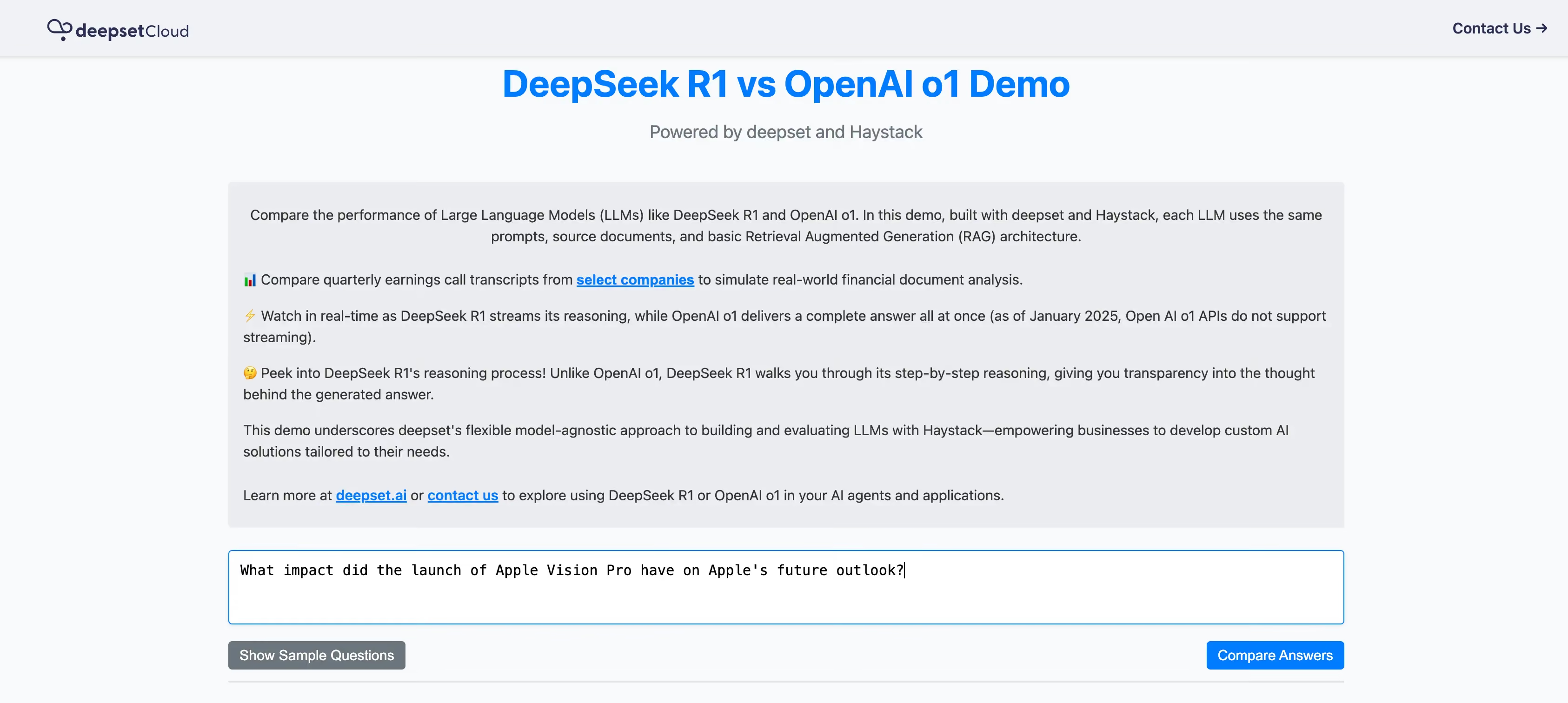
How to test DeepSeek with Haystack
To try out DeepSeek R1 yourself, check out our Haystack blog, Haystack tutorial or contact us to run it on your data in the Haystack Enterprise Platform.
Why model-agnostic design matters
The AI landscape is evolving rapidly, with organizations like OpenAI, Anthropic, Mistral, and now DeepSeek developing models that are constantly improving. When applied to business challenges, some excel in reasoning, others in contextual understanding or analytics, and yet others in efficiency or cost-effectiveness. Relying on a single model risks bottlenecking innovation and constraining potential use cases. By adopting a model-agnostic approach, you can:
- Leverage Model Diversity: Use the best model for the task at hand, whether it’s automating mutli-step problem solving, generating human-like text, answering complex questions, or performing domain-specific analysis.
- Future-Proof Applications: Test, swap or integrate new models as they emerge without rearchitecting your entire AI system or solutions.
- Optimize Costs: Dynamically balance performance and cost by routing tasks to models with the best cost-performance trade-off.
LLM orchestration frameworks and platforms to the rescue
LLM Orchestration frameworks like Haystack, the heart of the Haystack Enterprise platform, make model-agnostic design simple and seamless. They enable you to:
- Easily Switch Models: Plug and play different models into your AI pipeline.
- Combine Strengths: Use multiple models in tandem for tasks like multi-step reasoning, ensemble learning, or multimodality.
- Monitor and Optimize: Track performance metrics across models and refine routing decisions in real time.
Conclusion
The rise of DeepSeek reinforces the importance of model-agnostic design in AI development. By leveraging orchestration frameworks and platforms like Haystack, developers can seamlessly integrate multiple models, optimize for their specific needs, and remain agile in a rapidly evolving AI landscape.
The future of AI isn’t about choosing one model—it’s about being in control to harness all of the innovation in the AI space to build smarter, more adaptable solutions. To get started with Haystack contact us here.
Curious about building AI Apps and Agents?
meet the author

Table of Contents