
BLOG
AI Best Practices
Solutions
Harness Engineering: How to Build Reliable AI Agents by Engineering the System, Not the Model
Agent reliability comes from engineering the system around the model. Learn what harness engineering is, and how to classify and fix agent failures.

Published on
May 21, 2026
12
min read
TLDR
Key Metrics:
When an AI agent underperforms in production, the instinct is usually to fix the prompt or swap the model. These are reasonable starting points, but they only go so far. At some point the prompt is compensating for things that should be handled structurally, and the result is a system that's fragile, hard to debug, and tightly coupled to whichever model happens to be running.
The more durable investment is in the system around the model. Improvements there are faster to iterate on, cheaper to maintain, and keep working regardless of which model is running next week. And in most cases, it's where the real reliability gains are hiding anyway.
That system is the harness.
Harness engineering is the discipline of designing the systems, constraints, and feedback loops that wrap around an AI model to make it reliable in production. The agent harness is everything except the model: tools, memory, guardrails, verification, and orchestration. If you're building AI agents and wondering why swapping models isn't fixing your reliability problems, the harness is likely the missing piece.
Harness engineering is a new term. The problems it describes are not.
When we built Haystack, we didn't use the word harness. But the underlying conviction was the same: the logic that makes an agent reliable belongs in the system, not the model. Retries, routing, verification, memory, control flow should be explicit, inspectable parts of your pipeline, not hidden inside a prompt wrapper hoping the model figures it out.
That conviction shaped Haystack's architecture from the start. Pipelines are declarative graphs. You can swap components, add verification steps, or change routing logic without touching the agent's core prompt. Orchestration isn't abstracted away, it's made easy to inspect and adjust. When something breaks, you can see exactly where and why. When you want to change how your agent behaves, you change the pipeline, not a buried system prompt.
The practical consequence is that harness evolution is visible. Because pipelines serialize to YAML and live in version control, you can look at your git history and see not just what your harness does today, but how it got there and whether each change made things better or just more complicated.
We also think the trajectory of agent development points toward systems that look less like single monolithic agents and more like networks of specialized agents which are closer in spirit to microservices than to a single chatbot. Haystack's pipeline-first architecture is designed for exactly that: agents that compose cleanly, delegate to each other, and can be reasoned about as a system rather than a black box.
The term harness engineering is new. The discipline isn't, and if you've been building with Haystack, you've been doing it already.
What Is an Agent Harness?
An agent harness is everything in an AI agent system except the model itself. Tools for external actions, memory for state persistence, guardrails for safety, verification for accuracy, and orchestration for multi-step workflows. While the model provides raw reasoning, the harness transforms that capability into a reliable, auditable system.
The term was popularized by Mitchell Hashimoto (co-founder of HashiCorp, creator of Terraform) earlier this year in a blog post about his AI coding workflow. [1] His core insight resonated because it reframed how teams should think about agent failures: every time an agent makes a mistake, don't just hope it does better next time, instead engineer the environment so that specific mistake becomes structurally harder to repeat.
But there's a deeper point here that most descriptions of harnesses miss. A harness doesn't just support the model, it fundamentally changes the task the model is being asked to solve. Consider what an unaided language model actually faces. It has to:
- Hold all relevant history in a finite context window
- Reconstruct the right approach to a task from scratch on every run
- Figure out how to interact with external tools through free-form generation.
A well-designed harness transforms those problems into forms that the model handles more reliably. This is the engineering insight at the heart of harness design, and it shapes everything about how a good harness is built.
.avif)
- Context - the full engineered context the model receives at each step, including which memories to retrieve, which skills to load, and how the token budget is allocated across all of it
- Tools - the callable capabilities available to the agent, how they're described, and how they're progressively disclosed so a large tool catalog doesn't overwhelm the context window before the model even gets to the task
- Orchestration - subagent spawning, handoffs, model routing, and the control flow governing multi-step execution
- Guardrails and verification - permission boundaries, schema validation, output parsers, deterministic test suites, and secondary model evaluation that gate each step's output
How Agent Harnesses Externalize Memory, Skills, and Protocols
Production agents consistently fail in three distinct ways, and each one points to something that the model is being asked to manage internally that could be externalized in the surrounding “harness”.
State over time. Inference calls are stateless unless external state is persisted by the surrounding system. Every session starts blank. Without externalized memory, the agent has no record of what happened in previous runs, what decisions were made, what the user cares about, or what the environment currently looks like; it has to piece all of that together from scratch, every time. The harness converts a recall problem into a retrieval problem: instead of asking the model to remember, you ask it to read. That's a much easier task, and it's why well-designed memory systems improve reliability even when the underlying model doesn't change.
Procedural expertise. A capable model may know, in principle, how to do something, but reliable execution requires consistently following the right steps, in the right order, with the right defaults and constraints. Left to its own devices, the model will regenerate a workflow from scratch each time, and that regeneration introduces variance: steps get skipped, decisions get made differently, stopping conditions get missed. Splitting out that expertise into explicit skills such as reusable instruction artifacts that describe how a class of tasks should be carried out, converts improvised generation into guided execution. The model stops inventing the workflow and starts following one.
Interaction structure. Whenever an agent needs to call a tool, delegate to another agent, or surface a result to a user, it has to figure out how, including the right format, the right schema and the right lifecycle semantics. Without explicit protocols governing those interactions, every external action is partly a guessing game. Formalizing those contracts within the harness converts fragile, ad-hoc coordination into structured, governed exchange. It also makes those interactions auditable: when something goes wrong, you can see exactly what was called, with what arguments, and what came back.
These three dimensions: memory, skills, and protocols aren't just nice-to-haves. They're the specific forms of cognitive work that language models handle least reliably and that become dramatically more tractable when moved into explicit external infrastructure.
The Harness as Unifier
Critically, the harness isn't a fourth module sitting alongside memory, skills, and protocols. It's the layer that coordinates all three into a working system with the model. Memory accumulates experience but doesn't decide what's relevant right now. Skills encode how tasks should be done but need to be loaded at the right moment and bound to actual tools. Protocols govern interaction but need to be enforced consistently across every action the agent takes.
The harness is what makes these modules work in cohesion. It runs the agent loop, manages the context budget that memory retrieval and skill loading compete for, enforces the permissions that protocol calls are subject to, surfaces the traces that let you debug and improve the whole system. Without it, you have useful components that don't add up to a reliable agent. With it, each component makes the others more effective.
Why Harness Engineering Often Matters More Than Model Choice?
Raw models have specific, documented limitations that no amount of prompting fully solves. Understanding those limitations is what motivates every component of the harness, and it's also what clarifies when to rely on the model versus when to incorporate into a harness.
- Context rot is the first. As a context window fills up, model performance degrades as the agent loses track of constraints, drifts from earlier objectives, and produces output that doesn't match the original task. The harness solves this by externalizing state. Instead of cramming history into the model, it uses persistent state such as progress files, structured logs, external memory to keep the agent grounded without bloating the context window.
- No cross-session memory is the second. Every new session starts blind. The agent forgets everything from the previous run. Without a harness that persists state across sessions, the agent has no record of what came before. External memory fixes this by giving the agent a queryable store it can draw on at any point during a run — not just at the start, but whenever relevant context is needed to inform the next decision.
- Models have limited and unreliable self-verification is the third. Models produce confident output whether it's correct or not. A 10-step process with 99% per-step accuracy still only delivers around 90% end-to-end success and in practice, per-step accuracy is often much lower. Without verification loops built into the harness, mistakes propagate silently through every downstream step.
The evidence for harness-first engineering is empirical, not theoretical. The Terminal Bench results showed harness-only changes moving agents by 20+ ranking positions. Separate analyses found the same model running inside different harnesses producing wildly different performance, not because the model changed, but because the surrounding infrastructure did.
How Is Harness Engineering Different from Context Engineering?
Context engineering and harness engineering are nested, not competing. Context engineering manages what the model sees at any given moment: which documents get retrieved, how conversation history is assembled, which tool definitions are in scope. Harness engineering encompasses all of that, plus how the system operates over time - the memory that persists across sessions, the skills that encode how recurring tasks should be handled, the protocols that govern every external interaction, and the loop logic that ties it all together.
Getting the context right without a harness gives you a model that reasons well in isolation but drifts on real tasks. Building a harness without good context gives you solid infrastructure feeding the model the wrong information. You need both.
How Do You Make AI Agents Reliable in Production?
Reliability doesn't come from any single component. It comes from a systematic process for finding and fixing the specific ways your agent fails.
The core practice of harness engineering is an iterative loop: run the agent on real tasks, observe where it fails, classify the failure, update the harness, and repeat. Every cycle makes the environment smarter, even when the model stays the same. Tracing is what makes this loop possible; without structured logs of every tool call, model decision, and state transition, failure classification is guesswork. Haystack's built-in OpenTelemetry and Langfuse integrations auto-instrument each pipeline component, giving you the execution traces to diagnose exactly which layer broke and why.
Classify Failures, Then Fix the Right Layer
Not all agent failures are the same, and misdiagnosing the type leads to wasted effort. When an agent produces a bad result, ask which layer broke:
A context failure means the agent didn't have the right information at the right time. It hallucinated a database schema because it wasn't provided one, or it lost track of the objective because the conversation history overflowed its context window. The fix lives in your context engineering — retrieval logic, memory management, or how you structure what the model sees at each step.
A constraint failure means the agent had the information but did something it shouldn't have. It rewrote files outside its scope, ignored architectural boundaries, or called a tool it didn't need. The fix is a guardrail — a permission boundary, a linter rule, a scope limit that makes the bad action structurally impossible next time.
A verification failure means the agent produced output that looked plausible but was wrong, and nothing caught it. The fix is a feedback loop — a test suite, a format validator, or a second model acting as a reviewer that runs before the output is finalized.
A planning failure means the agent took the wrong approach entirely. It tried to solve the problem in one step when it needed five, or it went down a dead-end path and looped on the same broken strategy. The fix is in your orchestration logic — breaking the task into smaller steps, adding sub-agent delegation, or introducing loop detection that nudges the agent to reconsider its approach after repeated failed attempts.
This classification turns vague "the agent messed up" conversations into targeted harness updates. Over time, each fix accumulates — the harness absorbs the failure and prevents it from recurring.

Route Different Tasks to Different Models
Not every step in an agent workflow needs the same model. A high-reasoning model can handle planning and complex decision-making, while a smaller, faster model handles repetitive verification or data extraction. AI orchestration frameworks like Haystack already support this kind of multi-model routing, letting teams assign models per pipeline step based on cost, latency, and capability requirements. As the cost gap between reasoning tiers widens, this pattern is becoming standard practice rather than an optimization experiment.
Isolate Sub-Tasks to Protect the Main Context
For long-horizon tasks, subagents are one of the most powerful tools for maintaining coherence. The parent agent delegates a specific subtask to a subagent running in its own isolated context window. The subagent does the work such as research, implementation, data transformation and returns only the final result. None of the intermediate tool calls, failed attempts, or reasoning noise ends up in the parent's context. This keeps the main orchestration thread clean and focused, directly addressing context rot and extending how long an agent can operate before performance degrades.
Constrain More, Not Less
This is counterintuitive, but well-supported by production experience. Limiting what an agent can touch in a single task doesn't reduce effectiveness, it focuses it. A well-constrained agent produces higher-quality output because it can't wander into territory that creates downstream problems. Start restrictive and loosen as you gain confidence. It's far easier to remove guardrails from a working system than to retroactively add them to a fragile one.
Instrument Everything
A harness without observability is a harness you can't improve. Log agent actions, tool calls, token usage, and decision points. When the agent fails, these traces are what let you classify the failure and make the right harness update. Even simple file-based logging is enough to start. The goal isn't a perfect monitoring dashboard on day one but instead having the data to run the next iteration of the improvement loop.
Treat the Harness as a Living System
The improvement loop never truly ends. Run the agent on real tasks. Analyze the traces. Classify the failures. Update the harness. Repeat. Teams that adopt this practice consistently report that harness iteration delivers larger reliability gains than model upgrades, at a fraction of the cost.

How Do You Build Agent Harnesses with Haystack?
Architecting agent harnesses is an iterative process. Start with the failure types your agent hits most, build the components that address them, and refine the context your agent sees at each step. Haystack is built for exactly this kind of work, as an open-source AI orchestration framework, it gives you explicit, modular control over every harness layer without locking you into a single model or vendor.
Here's how each harness dimension maps to Haystack today:
- Design modular pipelines, not monolithic prompts. The biggest mistake teams make is stuffing all their logic into a single prompt and hoping the model figures it out. Haystack structures agent workflows as explicit, composable pipelines where each component including retrievers, routers, generators, tool invokers and memory layers can be tested, swapped, and improved independently. Add branches, loops, and conditional logic to control exactly how context flows through your system. When something breaks, you can isolate the failing component instead of debugging a black box.
- Externalizing state: memory. Haystack's composable pipeline architecture lets you attach memory layers: retrievers, document stores, state schemas as explicit components that persist and load context across sessions and steps. The state_schema on the Agent component lets tools accumulate documents outside the message stream, so retrieved content doesn't pollute the model's working context unless explicitly needed. The model reads a curated slice of relevant history, not a raw dump of everything that ever happened.
- Managing context budget: progressive tool disclosure. SearchableToolset implements progressive disclosure - the agent boots with a single search_tools function and only loads the full definitions of tools it actually needs. Rather than cramming every tool description into the context upfront, you surface the right capabilities when they're relevant and withhold them when they aren't. Jinja2-templated system and user prompts make context construction explicit and reusable across runs.
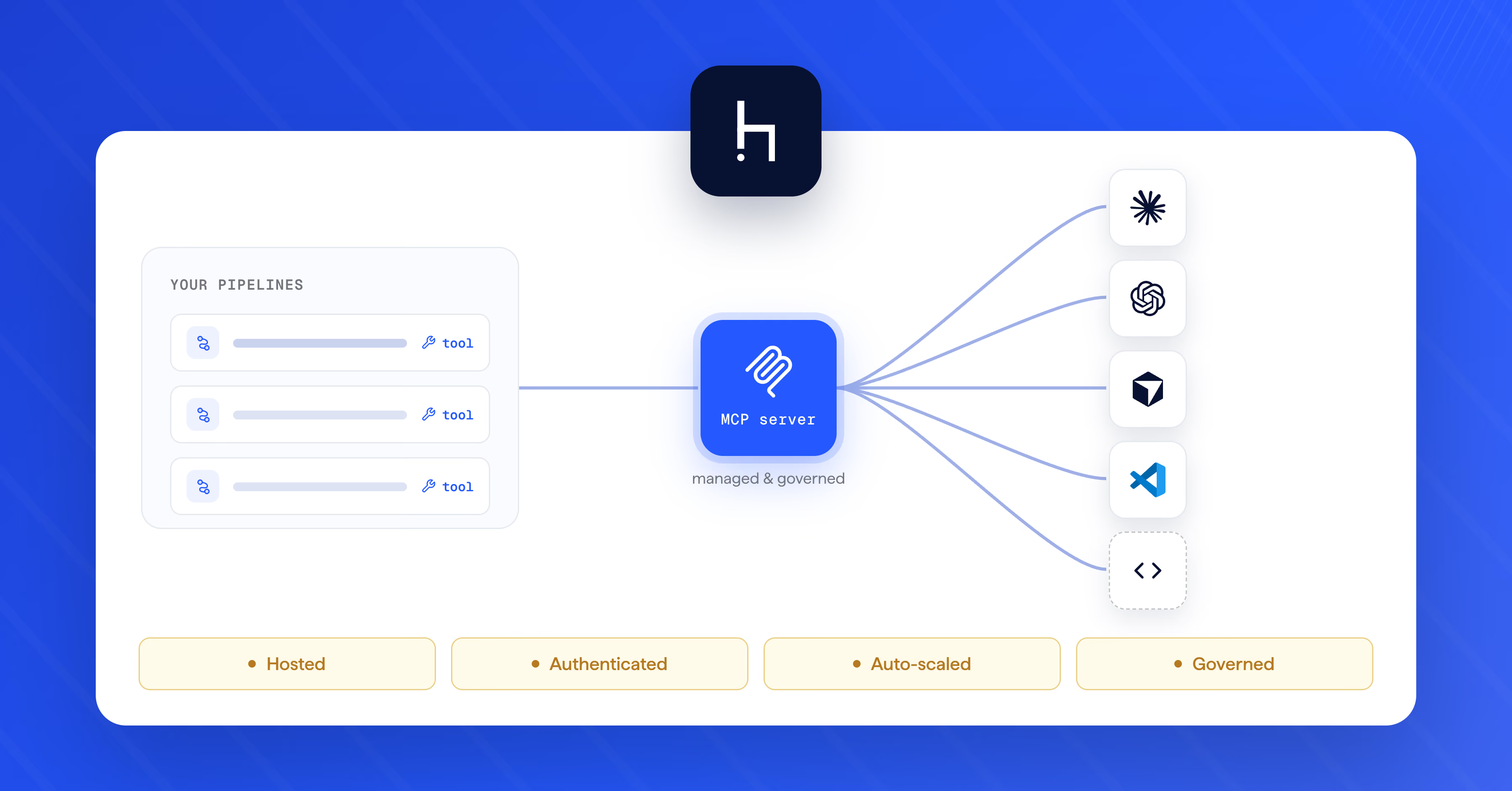
- Externalizing interaction: protocols and MCP. Haystack has native MCP support on both sides. With Hayhooks, you can expose any Haystack pipeline or agent as an MCP tool — making it available to AI dev environments like Cursor or Claude Desktop. Going the other direction, MCPToolset lets your agents connect to any MCP-compliant server and automatically load its tools, plugging into external data sources and services without custom integration code. Tool interactions follow governed contracts rather than ad hoc generation.
- Route models per step. Haystack is model- and vendor-agnostic by design, integrating with OpenAI, Anthropic, Mistral, Cohere, Hugging Face, Azure, AWS Bedrock, and local models. You can assign different models to different pipeline steps without rewriting your system - a high-reasoning model for planning, a smaller model for verification, a fast local model for data extraction. Multi-model routing as a first-class architectural pattern, not an afterthought.
- Loop control, oversight, and observability. Haystack's Agent component exposes exit_conditions, max_agent_steps, and state_schema directly, loop governance isn't hidden inside an opaque executor. The ConfirmationStrategy API lets you express fine-grained approval policies: ask once for a specific tool and then trust it, always require approval for operations that mutate production state, never interrupt for read-only operations. LangfuseConnector and OpenTelemetry tracing auto-instrument every component, and agent breakpoints persist a full snapshot to disk so a failed run becomes a debuggable artifact rather than a lost conversation.
- Integrate verification into the pipeline. Don't trust agent output by default. Haystack's composable architecture lets you wire evaluation and validation steps directly into the pipeline: linters, format validators, schema checks, or an LLM-as-judge that reviews output before it's delivered. These aren't bolted-on afterthoughts; they're components in the same graph, running as part of every execution.
- Isolate subtasks with multi-agent orchestration. Haystack supports using agents as tools for other agents. A main orchestrator delegates subtasks to specialized subagents operating in isolated context windows. The parent only sees the final result, not the intermediate noise, keeping your main reasoning chain clean and directly addressing the context rot problem for long-horizon tasks.
- Pipeline serialization as governance. Haystack pipelines serialize to YAML for reproducible configuration. That's not just a developer convenience, it means your harness configuration is a reviewable artifact that lives in version control, diffable in pull requests, deployable through CI, and inspectable by people who don't read Python. When something goes wrong in production, you can look at exactly what harness configuration was running at the time. When you want to roll back a change, you revert a file.
- Operating harnesses at scale: the Haystack Enterprise Platform. Open-source Haystack gives you the building blocks for every harness dimension. The Enterprise Platform is for teams where the harness itself becomes an organizational asset that multiple teams depend on and can be operated in regulated or compliance-sensitive environments. Concretely, that means: role-based access control so different teams can own different parts of the harness without stepping on each other; secrets management so credentials for tools, memory stores, and external services are handled securely rather than baked into pipeline configs; environment isolation so development, staging, and production harnesses are cleanly separated; and managed observability that gives both engineers and non-technical stakeholders visibility into what agents are doing, what they're spending, and where they're failing without requiring everyone to read trace logs.
The governance dimension matters especially for the approval gate and policy encoding layers of the harness. In a regulated environment such as finance, legal, healthcare, the question isn't just "can we build a human-in-the-loop step?" but "can we prove, to an auditor, that certain actions always required human approval, and here is the record of every time that gate fired?". The Enterprise Platform makes that audit trail a first-class output of the system rather than something you reconstruct after the fact.
What's Next for Harness Engineering?
As we look toward 2027, the discipline is moving from static scaffolding to dynamic governance.
Continual learning primitives. Instead of starting blind each session, harnesses are beginning to implement long-term memory that persists across weeks and months of operation. Agents onboard to a project by reading their own previous execution logs, progress files, and git history which collapses ramp-up time from days to seconds.
Shared agent infrastructure. Right now, most harnesses are built and maintained by individual teams for individual agents. The emerging direction is toward shared infrastructure: memory stores, skill registries, and protocol definitions that multiple agents draw on, maintained collectively rather than rebuilt from scratch each time. This changes the economics of harness engineering significantly, the fixed cost of building a good memory architecture or a well-specified skill library gets amortized across an entire agent ecosystem rather than borne by a single project.
Standardized agent protocols. MCP is standardizing the interface layer between agents and external tools. A harness built in Haystack can plug into any MCP-compliant data source or toolset without custom integration code, making the tool layer a commodity rather than a bottleneck.
Conclusion
The future of AI engineering isn't about finding the perfect model. It's about designing environments that make models reliably productive by externalizing the cognitive work they handle least well, formalizing the interactions they currently improvise, and building the feedback loops that let the system improve from every failure.
The role is shifting. AI engineers are becoming environment designers. Whether you're automating enterprise workflows or building knowledge discovery tools, the leverage is in the system around the model: the memory that gives it continuity, the skills that give it consistency, the protocols that give it structure, and the harness that coordinates all three.
Start with the improvement loop. Classify your failures by which layer broke. That's where the work is and where the results come from.
{{cta-light}}
Curious about building AI Apps and Agents?
meet the author
Table of Contents

.png)