
TLDR
Key Metrics:
Sovereign AI: What It Is, Why It Matters, and How to Build It
Sovereign AI has rapidly become a strategic focus not only for governments but also for enterprises across public and private sectors. At its core, sovereign AI refers to AI systems & applications that are developed, deployed, and governed entirely under a specific jurisdiction’s control - using that nation’s or organization’s own infrastructure, data, choice of models and tools, as well as talent. Traditionally driven by national security, regulatory compliance, and economic autonomy concerns, the concept is now gaining traction within regulated industries and commercial enterprises looking to maintain strict data control, compliance, and trust with customers and stakeholders.
This article explores the key motivations for the increasing awareness and adoption of sovereign AI systems, the underlying infrastructure and design principles, and evolving challenges and opportunities. As both governments and corporations seek to protect their data, enforce privacy by design, and differentiate with AI systems tailored to local needs and policies, sovereign AI is fast becoming a cross-sector imperative.
What is Sovereign AI?
Sovereign AI is defined as the idea that an entity has independent control over its AI systems, data, and infrastructure, where the entity may be a nation, a company, or a public institution. In practice, this means that AI systems, including models and services, are confined within defined legal and physical boundaries, whether that’s a country’s borders or a corporation’s private infrastructure. This local autonomy ensures compliance with jurisdictional regulations, enhances security, and allows alignment with specific cultural or organizational values.
Unlike conventional AI systems that may depend on global infrastructure, sovereign AI solutions are tailored to respect localized privacy standards, data governance policies, and operational control requirements. For companies, this could mean hosting proprietary AI models within their own data centers or certified cloud regions, using sensitive or classified datasets collected internally or from their specific customer or constituent base, and ensuring all processing complies with local laws such as GDPR, HIPAA, or sector-specific mandates.
Crucially, this model of AI governance does not imply complete technological isolation. As discussed in the World Economic Forum Whitepaper “Rethinking AI Sovereignty: Pathways to Competitiveness through Strategic Investments” many sovereign AI systems blend global open-source tools or commercial models with local customization, governance, and deployment strategies. For enterprises, this often involves deploying foundation models within a secure, private environment or fine-tuning third-party models with proprietary data. The emphasis is on operating AI on one’s own terms while retaining ownership of data pipelines, decision logic, and system behavior without being locked into opaque, foreign-hosted AI-as-a-service platforms.
What are the motivations and benefits of developing sovereign AI systems and deployments?
The motivations for adopting sovereign AI span a variety of strategic and operational drivers, which apply across public sector agencies and private sector organizations:
- Security and Business Continuity: Reduces reliance on third-party AI providers and mitigates the risk of service disruption or compromise due to geopolitical tensions or commercial dependencies.
- Data Privacy: Helps meet legal obligations around data sovereignty and privacy by ensuring all data handling and processing occurs within approved jurisdictions.
- Regulatory Compliance: The EU AI Act and similar initiatives put pressure on AI builders to document and control their AI systems’’ inner workings. For sovereign AI, the onus is on domestic institutions to create these guardrails and auditability processes. It’s a continuous challenge to keep AI systems interpretable, fair, and aligned with national ethical norms, especially as AI technology evolves rapidly, which is a key reason why Gartner recommends that sovereign organizations “implement model-agnostic workflows using open standards and orchestration layers.”. In short, sovereignty in AI doesn’t automatically solve AI ethics or safety issues, but does provide the control and customizability to solve them. They must still be rigorously addressed, often via new governance frameworks.
- Proprietary Value Protection: Preserves intellectual property and sensitive operational data by restricting model training, inference, storage, and retrieval to local environments.
- Ethical Alignment and Governance: Supports tailored AI governance aligned with national policy or organizational principles, including model and AI system transparency, fairness, and auditability.
- Customer Trust and Market Differentiation: Enables organizations to offer AI services that prioritize local compliance and ethical handling of data, serving as a competitive differentiator in privacy-conscious markets.
What are the main challenges in implementing sovereign AI systems?
Sovereign AI presents implementation hurdles despite its advantages:
- Infrastructure Investment: Building or maintaining dedicated AI infrastructure including compute, storage, and secure data pipelines, requires significant capital and operational expertise. These represent infrastructure investments alongside the sovereign requirement to build and run applications at the top layer, which must be ready for self-hosting.
- Talent Availability: Recruiting and retaining skilled AI engineers, ML researchers, and data infrastructure experts locally can be difficult, especially outside major tech hubs. This is why open source communities and forward-deployed engineering resources from partners become key requirements beyond pure technology capabilities.
- Technology Dependence: Achieving full independence from global technology providers can be complex. Key hardware (like GPUs) and foundational software frameworks may still be sourced externally. AI orchestration frameworks and platforms provide modularity to make sovereign what’s realistic today, while keeping other needed components replaceable when feasible.
- Standardization and Interoperability: Without globally accepted standards for sovereign AI systems, maintaining interoperability across jurisdictions and vendor ecosystems can be difficult. Standards like the Deutschland Stack, or D-Stack for short, are examples of localized technology frameworks. Organizations should expect to comply with multiple, overlapping standards, especially when operating globally. Again, AI orchestration provides an efficient and controllable path to build master solution templates that can be iterated upon locally.
How Do Sovereign AI Systems Ensure Compliance and Control by Design?
- Data stays on home soil (data localization): Sovereign AI systems ensure that all sensitive data – whether it’s training data or user inputs/outputs – is stored and processed within the national (or organizational) boundaries. This data localization is a game-changer for privacy and compliance. For example, if a European bank uses a sovereign AI platform hosted in-country, it knows that personal financial data isn’t leaving the EU, satisfying GDPR requirements by design. Similarly, government agencies can use AI on classified or personal citizen data with confidence that it’s contained in local servers and not subject to foreign surveillance. It also limits exposure: data isn’t traveling over international networks or residing in foreign data centers where other jurisdictions (or malicious actors) could theoretically access it. In short, sovereign AI localizes risk – containing data within known legal and physical confines reduces the avenues for privacy breaches.
- Avoiding foreign jurisdiction and third-party access: When using globally hosted AI services, data can become subject to the laws of whatever country the service provider is based in. A well-cited concern is the U.S. CLOUD Act, which could compel U.S.-based cloud companies to hand over data to American authorities, even if the data is stored abroad. Sovereign AI sidesteps this issue by keeping both data and compute under local jurisdiction. No foreign government or external entity can easily exert legal control over the data or algorithms. Additionally, running AI in a private sovereign environment means you’re not sharing resources with other unknown customers (as in a public cloud). There is no risk of data leakage via a shared service or multi-tenant cloud vulnerabilities – the AI system is typically hosted in a single-tenant (dedicated) manner for the organization or nation. This tight control greatly enhances security. All access to the system can be restricted to vetted local personnel and compliant service providers, reducing the attack surface. In essence, sovereign AI can be aligned with a zero-trust security posture more easily than a far-flung cloud service.
- Compliance with sector-specific regulations: Many industries have strict rules about data handling – think of healthcare’s HIPAA, finance’s various banking secrecy laws, or government classified data protocols. Sovereign AI can be architected to meet these compliance regimes by default. For instance, a sovereign health AI platform can enforce encryption standards, audit trails, and user access controls that align with health data regulations. Because the entire system is under the organization’s control, it’s easier to certify and document compliance. Sovereign AI systems allow organizations to align with frameworks like GDPR, CCPA, and other regulations, and even to adjust where specific data is processed based on what rules apply. This flexibility – deciding, for example, that certain datasets must only reside in a particular region’s node to satisfy local law – is a form of compliance by design. The system’s architecture itself enforces the rules, rather than relying on after-the-fact legal agreements. Moreover, if regulations change, a sovereign setup can be modified internally (e.g. update retention policies or refactor AI systems to remove certain data) without waiting on an external provider.
- Built-in governance and transparency measures: Designing an AI system for sovereignty often means including robust governance tools from the start. This could involve integrating AI “guardrails” – software frameworks that monitor and control the AI’s behavior for compliance and ethical standards. For example, a sovereign AI deployment might include modules that filter out prohibited content, bias-check the model’s outputs, or log every decision for audit purposes. Because the stakeholders (government or enterprise) define these rules, they can tailor the guardrails to local laws and values. Additionally, sovereign AI projects may opt for open-source models or require vendors to provide source code and documentation, increasing transparency. When an organization self-hosts an AI model, it has more freedom to inspect, tune, and validate the system’s inner workings. All of this contributes to accountability – if something goes wrong, there’s a clear chain of custody and the local team has the ability (and responsibility) to investigate and fix it. Essentially, sovereign AI allows a “compliance by design” approach where privacy and security considerations are baked into the architecture, not added on top of a black-box service.
- Enhanced security through isolation and customization: Sovereign AI environments can be optimized for security in ways that general-purpose clouds might not. For instance, they can be run on air-gapped networks or within hardened government data centers with strict physical security. Organizations can implement custom encryption for data at rest and in transit, use local key management, and ensure that even ML model artifacts are encrypted. They can also enforce that only devices within certain secure networks can access the AI. The level of granular control is higher. Furthermore, by controlling the software stack, one can ensure that all components (from operating systems to AIframeworks) are vetted and patched according to local security policies. There’s no unknown foreign subcontractor managing your servers – it’s all under your oversight. This dramatically lowers the risk of supply chain attacks or hidden backdoors. While no system is perfectly secure, a well-implemented sovereign AI setup reduces dependency on external trust; you trust your own vetted systems and people.
In summary, sovereign AI improves privacy, security, and compliance by its very architecture: data residency is ensured, jurisdictional entanglements are eliminated, and custom governance measures can be implemented at every layer. It gives organizations the peace of mind that they know exactly where their data is and who (or what) is touching it at all times. These benefits are a major reason why heavily regulated and security-conscious entities are drawn to sovereign AI solutions. By designing the AI environment in line with privacy and security principles from day one, sovereign AI can help prevent costly breaches and legal violations that might occur in a less controlled setup.
What does a sovereign AI-ready architecture look like in practice?
Specific architectural features characterize a sovereign AI system:
- Jurisdictional Compute Infrastructure: AI workloads are processed on hardware located within approved data centers, whether on-prem or hosted by a certified sovereign cloud provider.
- Local Data and Model Storage: Training and retrieval data, intermediate artifacts, and model checkpoints are stored within controlled environments, reducing risk of external access.
- Isolated Network Topologies: Secure communication protocols and segmented networks ensure restricted data movement and monitoring.
- Open, Modular Tooling: Adoption of open-source AI orchestration frameworks, containerized deployments, and modular governance tools enables flexibility without lock-in.
- Integrated Monitoring and Compliance Dashboards: Operational visibility and reporting features help validate adherence to legal, ethical, and technical standards. Embed observability tools and structured logging throughout the pipeline to enable compliance auditing and anomaly detection.
- On-Prem and Hybrid Inference Support: Models are deployed in ways that align with sovereignty needs—on-device, edge, or within co-located sovereign environments where latency or compliance demands it.
What are the technical risks of relying on non-sovereign, black-box AI models?
Relying on foreign or black-box AI models introduces operational and governance risks:
- Opaque Training Data: Organizations lack visibility into the datasets used to train third-party models, leading to unknown bias and compliance gaps.
- Model Drift and Reproducibility: Proprietary APIs may change behavior over time, making results inconsistent or unverifiable.
- Supply Chain Risks: AI infrastructure and models delivered as managed services may include insecure or compromised components.
- Compliance Violations: Using hosted models may breach data residency laws or sector-specific standards, resulting in legal penalties.
- Lack of Control: Inability to audit or modify decision logic can create ethical and liability concerns, particularly in regulated use cases.
The Future: Sovereignty as a Strategic Capability
The concept of sovereign AI is evolving beyond a national policy matter into a strategic capability that forward-looking organizations must consider. As privacy regulations intensify, AI models become more central to business operations, and geopolitical tensions persist, the ability to develop and operate AI systems independently and compliantly becomes a core requirement.
For companies, sovereign AI represents a shift from outsourcing AI capabilities to owning the critical aspects of the AI lifecycle. This not only reduces vendor lock-in but also enables innovation grounded in local context, proprietary insight, and organizational control. Sovereign AI systems can unlock new efficiencies, provide robust legal defensibility, and deliver ethical assurance - all of which are vital to sustaining AI at scale in a complex world.
Sovereign AI is no longer just a concern for policymakers, it is a pragmatic framework for any entity that views data as an asset, AI as a differentiator, and trust as a cornerstone of long-term success.
As organizations across sectors pursue sovereign AI strategies, open-source and orchestrated platforms play a critical enabling role. Frameworks like Haystack and orchestration platforms such as the Haystack Enterprise Platform provide a modular, extensible foundation that supports on-premise and VPC deployments, crucial for maintaining data residency and jurisdictional control.
Haystack enables teams to build custom agent and retrieval-augmented generation (RAG) pipelines using open models and configurable components. This flexibility allows organizations to fine-tune and govern AI behavior at every stage, from document parsing to ranking, tool calling and generation while using their own infrastructure and proprietary data. It avoids black-box dependencies and supports full traceability and AI system observability.
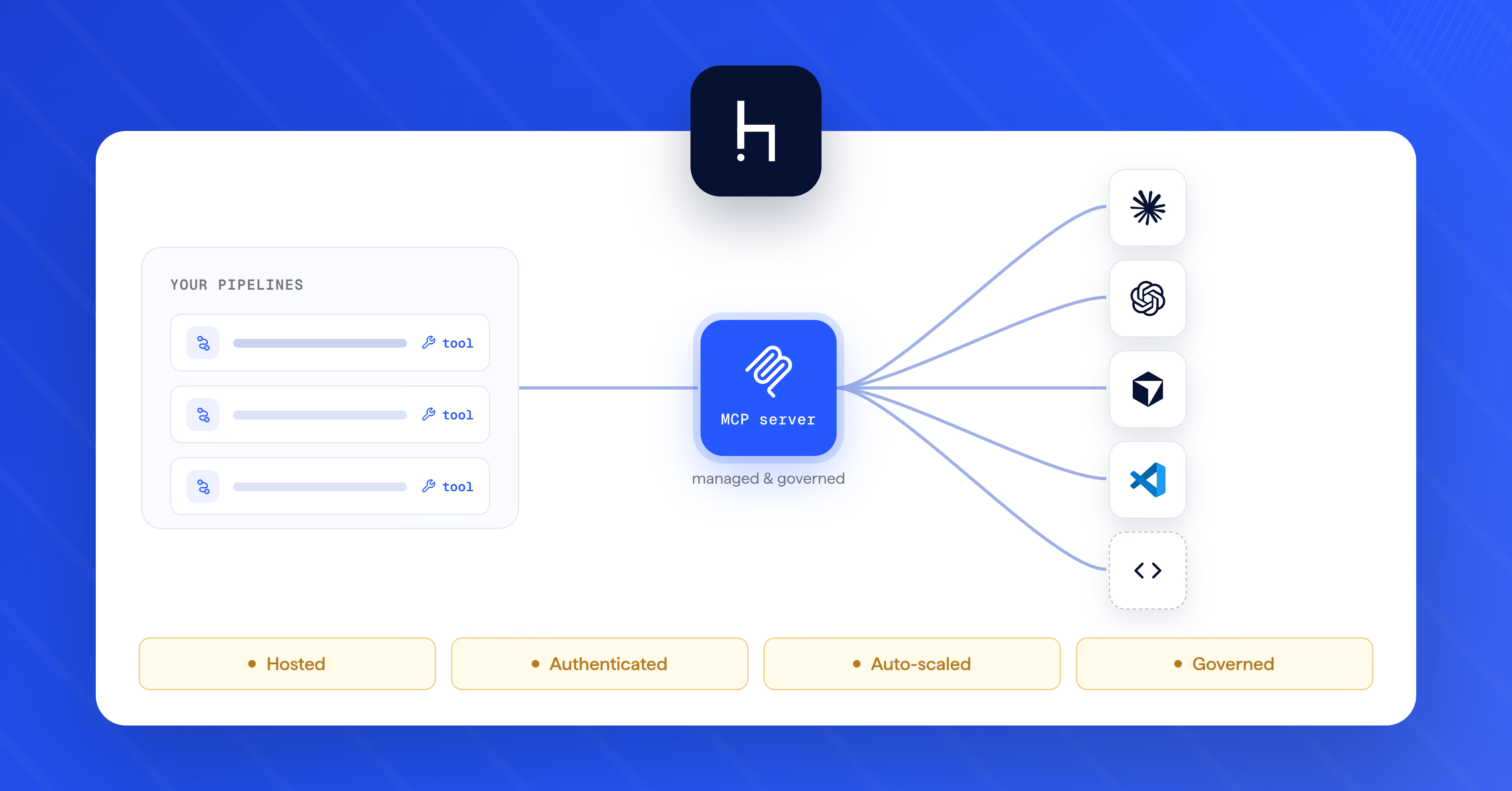
The Haystack Enterprise Platform extends this with orchestration capabilities designed for production-grade LLM applications, enabling audit-ready deployment, CI/CD integration, versioning, access control, and runtime monitoring. It gives technical teams sovereignty over not only models and data, but rather the full pipeline logic, performance metrics, and compliance settings.
Together, these tools represent a viable path forward for organizations seeking sovereignty without sacrificing scalability or innovation. By combining open, controllable tooling with deployment flexibility and compliance-first design, companies and governments can take decisive steps toward building AI systems they fully own and understand.
{{cta-light}}
Curious about building AI Apps and Agents?
meet the author

Table of Contents

.png)